In this guide
- Separate the label from the garment
- Define the discomfort you want to avoid
- Compare cotton in the form you will wear
- Treat linen as a garment choice, not a magic word
- Ask what a performance claim actually describes
- Use fit to support the intended activity
- Plan the transition indoors
- Compare two outfits for the same commute
- Compare a small number of real options
In humid weather, choose clothing by looking at the whole garment: its weight, construction, fit, moisture handling, and the activity you expect. Cotton, linen, and performance fabric are useful starting descriptions, but none of those words guarantees that a particular shirt will feel comfortable during your day.
Start with the situation you actually need to dress for. A short walk to an air-conditioned office, a long outdoor afternoon, and an active commute create different demands even when the forecast uses the same temperature.
Separate the label from the garment
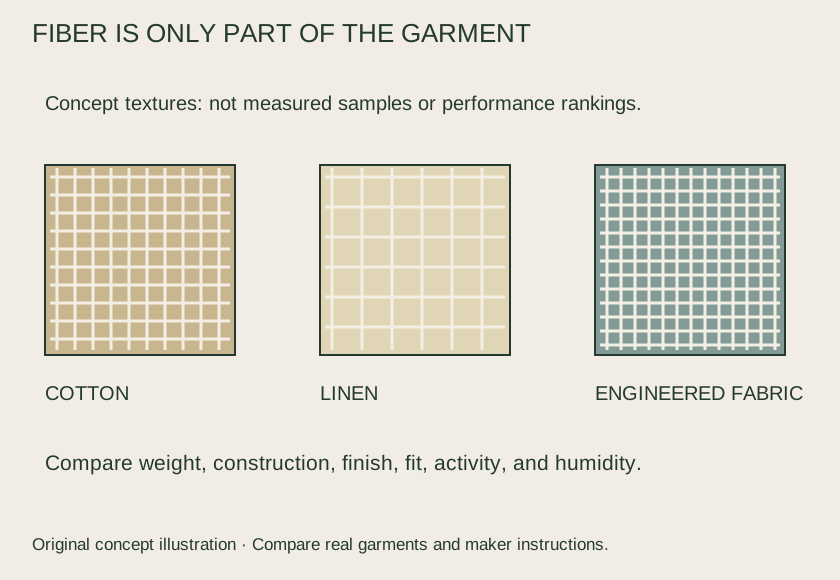
Read the fiber content, then look at the fabric and cut in front of you. A dense cotton overshirt and a lightweight cotton tee can behave differently because the fiber name does not describe their entire construction.
The same applies to linen and polyester. Compare the actual weight, weave or knit, finish, lining, and room around your body rather than assigning every garment in a fiber category the same performance.
CottonWorks’ TransDRY material is one example of cotton being engineered for particular moisture-management behavior. That illustrates why the phrase performance fabric can describe a treatment or construction, rather than a single separate fiber.
If a product page gives only a broad comfort claim, recognize what remains unknown. You can ask for more detail or compare a garment you already know instead of treating the marketing label as measured evidence.
Define the discomfort you want to avoid
Think about what bothered you in a previous outfit. The issue might have been a heavy damp shirt, restricted air movement, a fabric that clung, or a layer that felt unnecessary once you reached your destination.
Those are different problems and may call for different changes. Buying another fiber without changing the weight or fit can leave the original source of discomfort untouched.
Write a short description of the day you are preparing for, including time outdoors and likely activity. This gives you a concrete basis for comparing clothing rather than collecting contradictory claims about the best summer fabric.
If your conditions involve dangerous heat or job-specific exposure, clothing choice is only one part of the plan. Use the relevant official weather and workplace guidance rather than treating a fabric label as protection from heat illness.

Compare cotton in the form you will wear
Cotton can be a comfortable option for ordinary warm-weather outfits, but the actual garment still matters. Check whether the fabric is light enough for your use and whether its shape allows the movement you need.
Consider what happens during your commute or other active period. If a particular cotton shirt becomes heavily damp and stays uncomfortable for you, record that experience instead of assuming every cotton item will respond the same way.
You might compare a lighter construction, a different cut, or a purpose-designed garment for the active portion of the day. That is a more specific experiment than replacing an entire wardrobe based on the fiber name alone.
Also check the care routine and whether you have enough clean options. A summer shirt is less useful if its drying or finishing requirements do not fit the way you can maintain it through a busy week.
Treat linen as a garment choice, not a magic word
The Alliance for European Flax-Linen and Hemp describes laboratory work on linen’s comfort properties. Those findings provide useful fiber context, but they do not establish that every linen garment outperforms every alternative in every humid setting.
Look at the linen shirt’s construction and fit, including whether it has a lining or other layers. A roomy lightweight shirt offers a different wearing experience from a dense, closely fitted piece that happens to share the same fiber.
Decide whether you enjoy the garment’s texture and relaxed appearance during normal wear. If you dislike how a particular shirt looks after sitting, that preference matters even when you like the idea of linen for summer.
Try it with the pants and base layer you intend to use. The complete outfit can introduce extra bulk or coverage that a photograph of the shirt alone does not show.
Ask what a performance claim actually describes
Read the product’s explanation of moisture wicking, quick drying, ventilation, or other claimed features. These phrases describe different things and should not be treated as interchangeable promises of feeling cool.
A wicking design concerns moving moisture through or across the fabric, while drying involves moisture leaving it. REI’s hot-weather guidance discusses clothing and environmental conditions together, which is a useful reminder that the surroundings affect the result too.
Look for details tied to the exact model, not a general technology page for another garment. A fabric family may include several weights and constructions with different intended uses.
Avoid assigning a numerical advantage without an applicable test. You can choose a garment because its documented design fits your activity while remaining honest that you have not measured its performance against another shirt.
Use fit to support the intended activity
Try the garment while standing, sitting, and reaching, then consider the layer you will wear over or beneath it. A comfortable shape in isolation may become restrictive once a bag strap or outer layer is involved.
For casual use, you may prefer room for ventilation and a fabric that does not cling in a way you dislike. For an active garment designed to sit closer, follow its intended sizing and assess how it works during your activity.
Do not assume that the loosest possible clothing is always the best answer. You still need a shape that lets you move appropriately and does not create practical interference with the task.
Likewise, do not size down just because a garment is described as technical. The maker’s fit guidance and your actual comfort are more useful than a rule borrowed from a different sport or product.
Plan the transition indoors
If you spend part of the day in air conditioning, consider a removable layer rather than making the base garment handle every environment alone. Check that the layer packs or carries comfortably when you do not need it.
An active commute may also justify changing into a clean top on arrival when your facilities and schedule allow it. That can be a more reliable solution than expecting one shirt to remain presentation-ready through every condition.
Keep the change practical: where will the worn item go, and how will it receive appropriate care afterward? A damp shirt should not disappear into a closed bag until the next day without thought.
If a change is not realistic, choose a base outfit that fits the most demanding part of the day and remains acceptable for the rest. Make the tradeoff consciously instead of discovering it halfway through the journey.
Compare two outfits for the same commute
Suppose your route includes a twenty-minute walk followed by several hours indoors. Compare the complete outfits, including any undershirt, bag, and layer, rather than judging a linen shirt alone against a fully layered cotton outfit.
If one version feels better, note the likely contributors without claiming a controlled fabric test. A lighter construction, more room across your back, or leaving an unnecessary layer in the bag may explain part of the difference alongside the fiber.
Compare a small number of real options
Choose two garments you already own or can assess under the seller’s actual conditions. Keep the activity and other layers similar enough that you can understand the difference you notice.
Record concrete observations such as clinging at the back, collar comfort, or how the fabric feels after the commute. Separate those observations from a broad claim that one fiber is always superior.
You may end up using cotton for one kind of day, linen for another, and a documented performance garment for an active journey. That is a practical wardrobe decision rather than a failure to identify a single winner.
The goal is clothing that suits your conditions and remains easy enough to care for. Fiber content helps you begin the comparison, while the actual garment and your day determine the useful answer.
Sources & editorial notes
Primary pages checked October 22, 2026. Practical scenarios and style judgments are editorial explanations; exact garment and product instructions take priority.
- cottonworks.com — Performance properties may come from engineered cotton construction or finish; no numerical comparative test claimed.
- allianceflaxlinenhemp.eu — Linen comfort properties studied in controlled laboratory contexts; not a universal finished-garment ranking.
- rei.com — Clothing choice depends on activity, moisture handling and environment.