In this guide
A ten-piece work wardrobe can cover five days when the pieces suit your actual workplace and work with one another. The useful starting point is your weekly schedule, not a shopping list of supposedly essential items that may have nothing to do with how you spend your days.
For this planning exercise, count your main visible garments and shoes, and treat underwear, socks, and weather-specific protection as separate necessities. You are testing a manageable selection from your closet rather than promising that ten pieces can meet every job, climate, or dress code.
Write down the real week
List the five days and anything that changes what you need to wear. A client meeting, long commute, presentation, informal desk day, and dinner afterward can create different demands within the same week.
Check your employer’s actual expectations before borrowing a business-casual example. Charles Tyrwhitt’s guide offers a range of combinations, but a retailer’s styling suggestion does not override your workplace’s requirements.
Also note the practical conditions: indoor temperature, walking distance, rain exposure, and whether your work has protective-clothing requirements. This exercise is for ordinary non-protective office dressing, not a substitute for job-specific equipment or uniform rules.
Once the schedule is visible, identify the hardest day to dress for. Build a comfortable outfit for that day first, since easier days can often use simpler versions of the same pieces.
Take inventory before choosing the ten
Lay out the work clothes you already wear willingly. Exclude pieces that need repair, do not fit, or only work after a care routine you cannot realistically complete that week.
Choose garments you can sit, reach, and walk in comfortably. A shirt that looks excellent on a hanger but distracts you throughout a meeting is a weak foundation for a small wardrobe.
Notice which colors and shapes already connect. If most of your useful pants are navy and gray, you do not need to add an unrelated color merely to make the selection look more varied on a bed.
Keep one separate reserve outfit available if your circumstances require it. A ten-piece planning exercise is not a reason to leave yourself without a practical option when something spills or needs cleaning unexpectedly.
Build a sample selection with clear roles
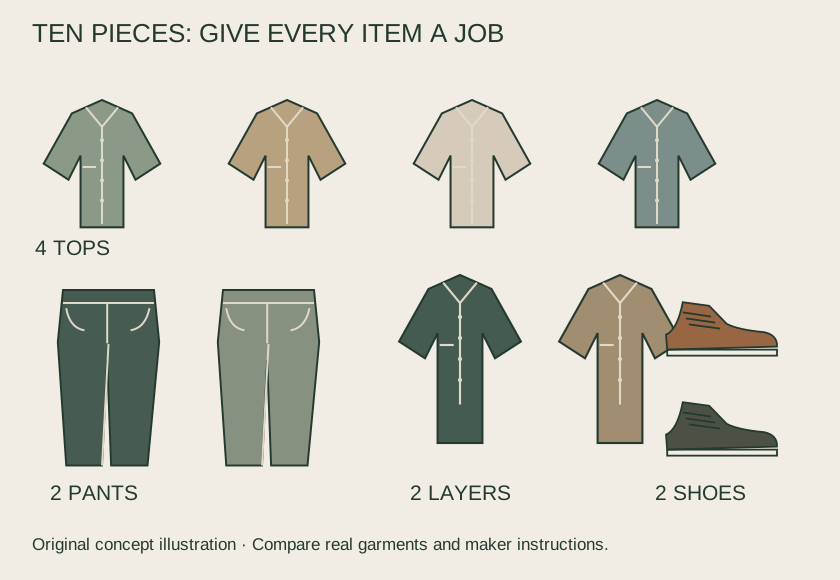
One workable example is four tops, two pairs of pants, two layers, and two pairs of shoes. That is ten pieces, but it is a starting arrangement you can change rather than a universal capsule formula.
You might choose two shirts, a polo, a fine knit, navy pants, gray pants, an overshirt, a blazer, loafers, and simple leather sneakers if your workplace permits them. A more formal office may call for a different selection entirely.
Give each item a role in at least two plausible outfits where possible. A layer that works only with one shirt may still earn its place, but you should know that it is a specialist rather than imagining it adds unlimited combinations.
For shoes, choose pairs you can actually wear for the commute and workday. A second pair adds little value if it is uncomfortable enough that you always reach for the first one instead.
Make five complete outfits
Assign a full combination to Monday before counting theoretical mix-and-match possibilities. Include the shoes and layer, because they can change both the dressiness and practicality of the result.
Then plan Tuesday through Friday around the schedule you wrote earlier. Repeating pants or a layer is fine; decide which pieces need cleaning or airing based on their condition and their own instructions.
For example, you might reserve the blazer and more formal shoes for a meeting, then use the overshirt and another top on a quieter day. This gives the week a rhythm without requiring five unrelated identities.
If an outfit depends on an item you do not own, mark it as a gap rather than silently adding it to the ten. Try a suitable existing alternative before deciding that the gap deserves a purchase.
Check combinations physically
Try on the outfits instead of relying only on a grid of item names. A shirt and sweater may coordinate in color while bunching together uncomfortably at the neck or sleeves.
Check the pants with both shoe pairs and decide whether the hem works acceptably with each. You may discover that one pair belongs with a particular shoe shape, which is useful information for your weekly plan.
Look at the outfit with and without the outer layer. If your office is warm enough that you regularly remove a blazer, the underlying shirt-and-pants combination should be one you are happy to wear on its own.
Take quick reference photos if they help you get dressed on rushed mornings. They are reminders of combinations you already checked, not evidence that an outfit must remain perfectly arranged throughout the day.
Plan care around the week
Read the labels of the selected items and identify any piece that needs a specific drying space or professional care. A small wardrobe becomes inconvenient when several key items are unavailable at once.
Do not schedule a shirt for consecutive days simply because the exercise looks tidy on paper. Decide whether it is actually ready to wear again after use, especially when it has been close to your skin during a warm commute.
Keep a visible place for items awaiting care so they do not disappear back into the ready-to-wear section. A simple separate hanger or laundry area can make your morning decision more accurate.
If your laundry access is limited, adjust the mix rather than forcing the original example. More washable tops and fewer optional layers may serve you better than a capsule built around someone else’s routine.
Use accessories without hiding a weak base
A belt, watch, or different sock color can change the feel of a familiar outfit, but the main pieces still need to work. Do not rely on accessories to make uncomfortable pants or an unsuitable shirt seem like a good choice.
Keep the accessories practical for your day and the workplace. If you normally remove a watch or ring for a task, include that reality in the plan instead of designing only for the commute photograph.
You do not need to count every small accessory in this particular ten-piece exercise. If accessories are your main source of variety, write them beside the outfits so you remember how you intended to use them.
Likewise, weather protection can sit outside the count without becoming invisible. A raincoat or winter layer may be essential even though it does not form part of the indoor office outfit you are planning.
Repair the weak connection
After the first week, identify which planned outfit you skipped and why. The answer may be temperature, fit, care, dress code, or simply a combination you did not enjoy once you wore it.
Change the relevant item or pairing rather than buying a whole new capsule. If every outfit works except the one using a particular polo, investigate that polo’s role before replacing the pants and shoes around it.
You can also shift the category balance. Someone who wears a jacket every day may need another useful layer, while someone in a relaxed office may get more mileage from an extra clean top.
Avoid turning the exercise into a competition to own the fewest possible pieces. The count is a constraint that reveals useful relationships, not a measure of taste, discipline, or environmental virtue.
Keep the useful version
Save the five outfits that survived real wear and note any care timing that mattered. Next week, begin with that tested plan and change only what your schedule or weather requires.
A successful ten-piece selection should make your mornings simpler while still leaving room for comfort and appropriate dress. If a slightly larger or smaller selection does that better, use the version that supports your actual week.
Sources & editorial notes
Primary pages checked October 22, 2026. Practical scenarios and style judgments are editorial explanations; exact garment and product instructions take priority.