In this guide
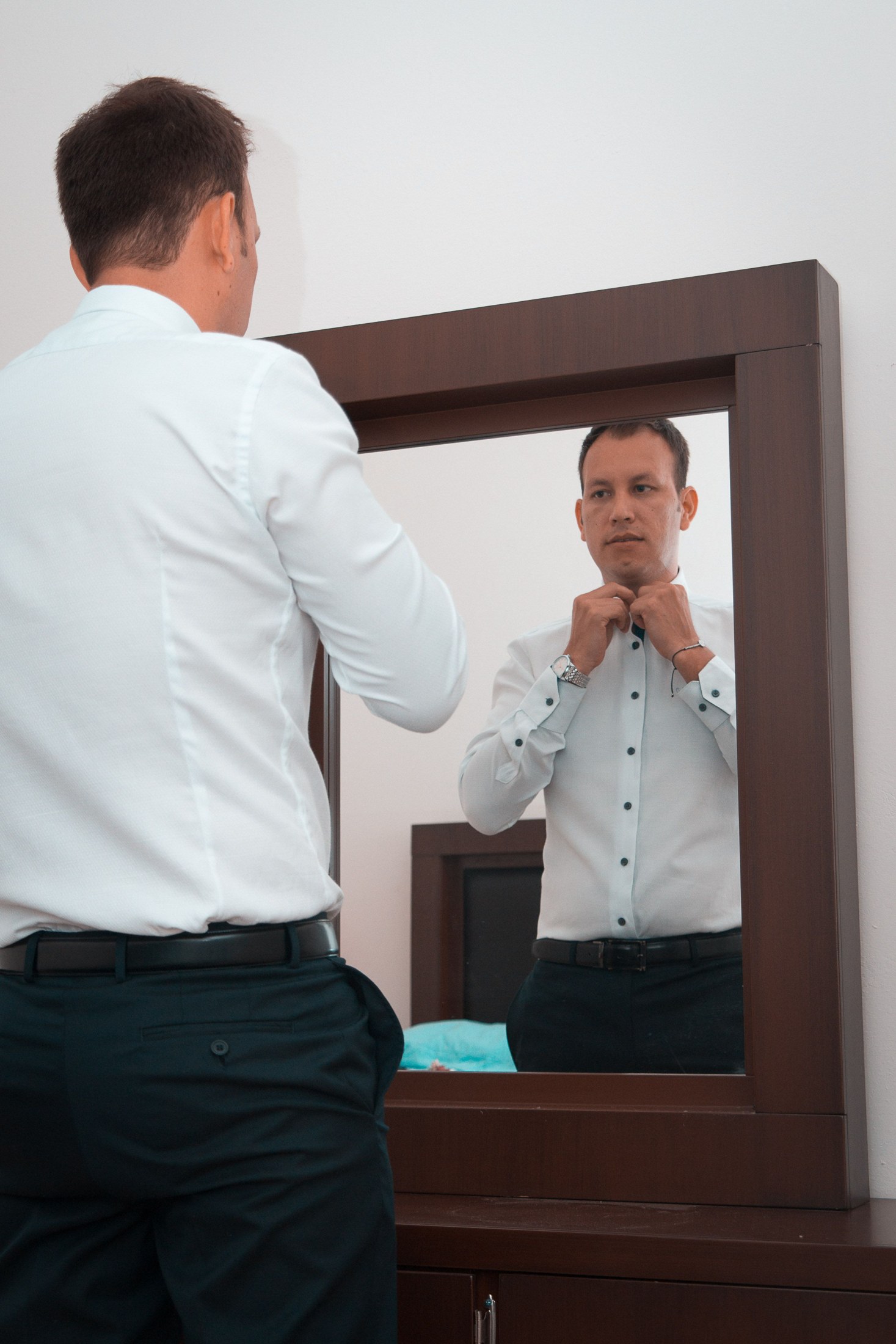
A casual shirt fits when you can use your arms, sit comfortably, and wear the hem the way you intended without spending the day pulling everything back into place. The mirror matters, but the useful check happens while you move through a few ordinary actions.
You are not trying to find one universal amount of looseness. You are deciding whether this shirt’s cut, fabric, and length work for your body and the situations where you expect to wear it.
Start with your actual outfit
Try the shirt with the pants and undershirt you expect to wear, rather than judging it over unfamiliar layers in a fitting room. A higher waistband, a thick tee, or a different tuck changes the relationship between the pieces.
Fasten the buttons you would normally fasten and let the shirt settle without pulling its sides into a flattering position. Stand naturally, with your shoulders relaxed and your feet where they usually land.
Look at the front, side, and back if a second mirror is available. A front view can look tidy while the back hem catches on your waistband or the upper sleeves feel tight when you reach forward.
Keep your usual posture instead of holding a deep breath and standing like a mannequin. The shirt has to work during your day, including the less photogenic moments when you sit at a desk or carry a bag.
Check the shoulder without making it the only rule
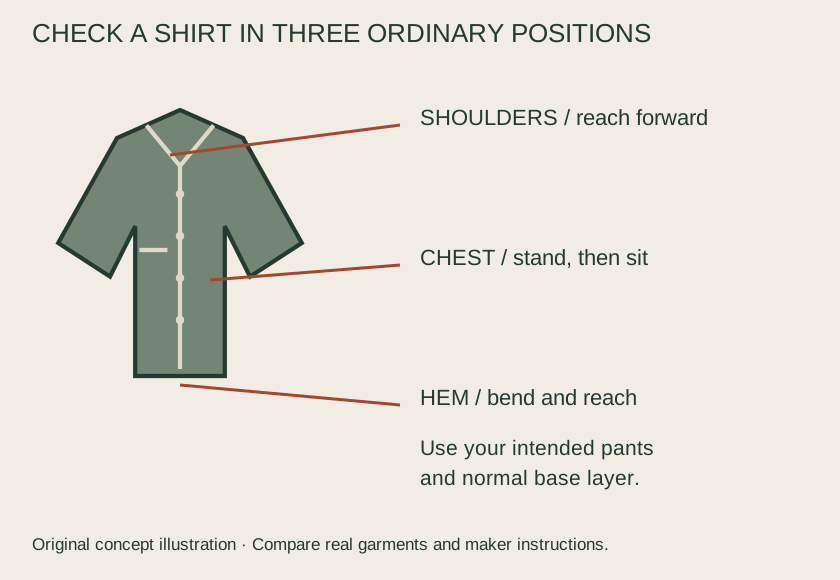
Notice where the shoulder seam sits relative to your shoulder and how the fabric continues down the sleeve. On a conventional set-in sleeve, a badly misplaced seam can be a useful clue that the base size or cut needs another look.
A deliberately dropped shoulder is a different design, so do not reject it for failing a tailored-shirt rule it was never meant to follow. Compare the intended silhouette with what you see on yourself and the maker’s actual product description.
Now reach both hands forward as if you were holding a steering wheel. Notice whether the upper back allows the movement or whether you feel pulled across your shoulders before your arms get where they need to go.
You do not need a perfectly motionless hem during that reach. You do need enough usable movement that you would not avoid an everyday task to protect the appearance of the shirt.
Read the chest while standing and sitting
Look at the button line while you stand, then sit in a normal chair. If gaps open between buttons, decide whether they reflect a base-size problem, a cut that is too narrow, or an undershirt adding more bulk than expected.
Do not assume that moving every button slightly will solve a shirt that feels tight across several areas. Try the next size or another fit before turning a basic purchase into a collection of small repairs.
A little room can be part of a relaxed silhouette. The question is whether you like how that room hangs, not whether you can force all spare fabric behind your back for a photograph.
For example, a roomy Oxford can work with straight pants and a casual jacket even though it would look loose under a very close-fitting blazer. That is an outfit decision rather than proof that the shirt is incorrectly sized.
Give your elbows a job
Bend each arm as if you were drinking from a mug, reaching for a shelf, and typing. Check the upper arm and elbow separately, since a sleeve can feel generous in one place and restrictive in another.
If you have to rotate the cuff or pull the sleeve upward before every bend, try another size or sleeve shape. You are looking for a garment that follows ordinary movements without needing a preparation ritual.
Proper Cloth notes that sleeve measurements can start at different points depending on the maker. Before comparing a number from one shirt to a chart, establish whether it runs from the center back of the neck or the shoulder seam.
That distinction is especially useful online, where two identical-looking numbers may describe different distances. A measuring method can be wrong for your comparison even when the tape itself is perfectly accurate.
Decide what the cuff should do
Fasten the cuff at the position you would use, including a watch if you normally wear one. Check whether your hand can move comfortably and whether the cuff stays reasonably where you want it as you bend your arm.
An open, rolled cuff is a styling choice, but it should not be your only way to tolerate a sleeve that otherwise restricts you. Try the shirt unrolled first so you understand the actual fit you are buying.
If the sleeves are long but the body fits well, ask a tailor whether shortening them makes sense for the construction. If the shoulders, chest, and upper arms also feel wrong, a sleeve alteration does not resolve the larger mismatch.
Short sleeves need their own check at the opening. Raise your arms enough to see whether the edge catches or binds, then lower them and decide whether you like the way the sleeve stands away from your arm.
Test the hem as you intend to wear it
For an untucked shirt, look at the front and back lengths with your normal waistband. A hem you like standing still may look different once you sit or put your hands into your pockets.
Bend to pick up a bag and reach above shoulder height once. If the hem rises more than you want, decide whether a longer shirt, a different rise in your pants, or another cut would better suit your day.
For a tucked shirt, sit, stand, and walk a few steps before inspecting the tuck. Notice whether a small adjustment restores it or whether the body pulls almost completely free every time you move.
You do not need to pretend that any shirt stays perfectly arranged through unlimited movement. You are checking whether the amount of adjustment feels reasonable for the way you dress.
Add the layer you actually use
Put on your usual overshirt, sweater, or casual jacket if that combination matters to you. Look for sleeves bunching near the elbow, fabric collecting around the collar, or a hem arrangement you find awkward.
Try removing the layer again without tugging the shirt into place first. This gives you a more honest view of what the outfit looks like when you move between an air-conditioned room and the street.
A close-fitting shirt is not automatically a better layering shirt. You may prefer some room in the base garment, especially if the outer layer also needs space for you to reach and sit comfortably.
Conversely, a very generous shirt may create more bulk than you want beneath a narrow sweater. If both pieces work separately, keep the shirt and change the pairing rather than declaring either garment universally wrong.
Compare two options with the same checks
When two sizes seem plausible, repeat the same actions in both. Use the same pants, fastening, chair, and reach so that you are comparing fit rather than two different ways of standing.
Write down the one or two things that matter most: perhaps upper-back movement and untucked length. This keeps a minor sleeve detail from distracting you from the reason you were uncomfortable in the first size.
If sizing up fixes your chest but leaves far more body volume than you want, try another cut instead of assuming you must choose between tight and enormous. Brands often offer different fit shapes within the same broad size label.
Before removing tags, check the care instructions and the return conditions for your purchase. You want to settle the fit while you still have the options the seller actually offers, without assuming a wash or alteration will preserve them.
Your final check is simple: can you imagine getting dressed and forgetting about this shirt for a while? A fit that supports your normal movements is more useful than one that looks perfect only while you stand still.
Sources & editorial notes
Primary pages checked October 22, 2026. Practical scenarios and style judgments are editorial explanations; exact garment and product instructions take priority.