In this guide
- Start with a clear version of the formula
- Use actual wears when looking backward
- Treat future wears as scenarios
- Keep affordability separate from efficiency
- Include costs that change the decision
- Notice the needs the formula misses
- Compare against what you already own
- Check a repair with forward-looking numbers
- Use a small decision note
Cost per wear divides a garment’s cost by the number of times you wear it. It can help you compare realistic wardrobe choices, but it becomes misleading when you use an optimistic future wear count to make an expensive purchase feel inevitable.
Use the calculation as a question about your habits, not a verdict on whether you deserve an item. A useful result supports your budget and actual wardrobe needs without pretending that every enjoyable or necessary garment must win a numerical competition.
Start with a clear version of the formula
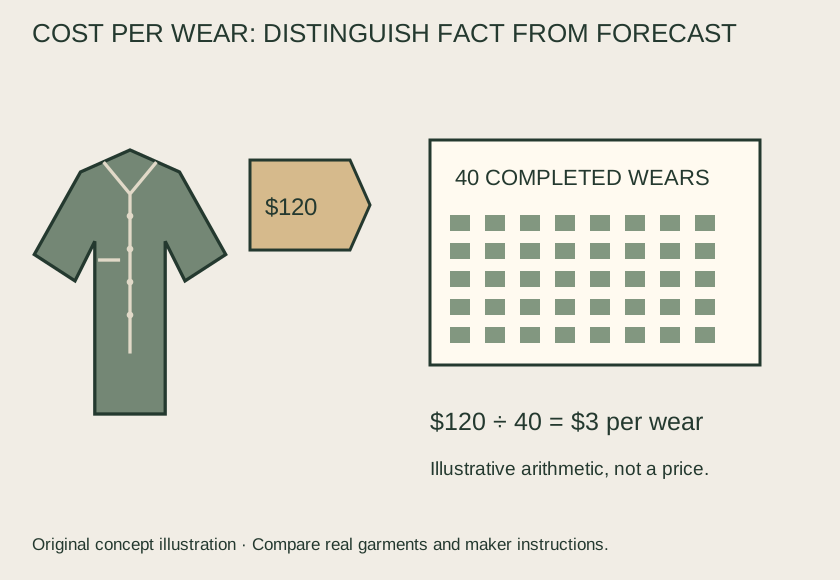
For a simple check, divide the amount you paid by the number of completed wears. If an illustrative jacket costs $120 and you wear it 40 times, the purchase-price cost per wear is $3.
That example is arithmetic, not a current price or a claim about how long any real jacket will last. You can use your own numbers while keeping the same distinction between a completed wear and an imagined future one.
Decide what you mean by cost before comparing two items. Purchase price alone is simple, while a fuller version might include necessary alterations or care costs that you can reasonably attribute to the garment.
Do not compare a purchase-only figure for one item with an all-in figure for another without saying so. The numbers may look precise while answering different questions.
Use actual wears when looking backward
Choose a garment you own and estimate its completed wears as honestly as you can. A calendar note or rough weekly pattern may be enough for a practical check without building a detailed tracking system.
If the estimate is uncertain, use a range. A shirt worn somewhere between 20 and 30 times should not be treated as if you know the exact count merely because a calculator can display several decimal places.
For an illustrative $60 shirt, 20 wears gives $3 per wear and 30 gives $2. That range communicates the uncertainty more clearly than choosing a convenient middle number and forgetting it was an estimate.
You can learn from a high figure without turning it into self-criticism. The item may have served a rare event, become unsuitable after a change in your circumstances, or simply taught you something about your preferences.

Treat future wears as scenarios
Before a purchase, you do not know the final wear count. Build a low, middle, and high scenario based on the occasions you can actually identify rather than assigning years of frequent use automatically.
For example, an illustrative $150 pair of shoes would be $15 per wear at 10 wears, $5 at 30, and $2.50 at 60. Each result depends on whether those wears happen, not on how convincing the product page looks today.
Ask which scenario resembles your routine and existing choices. If you already avoid similar shoes because they are uncomfortable for your commute, a high-frequency forecast needs more justification than the phrase wardrobe staple.
Include the possibility that your needs change. A different workplace, size, climate, or daily schedule can alter the opportunities to wear something even when the item remains in good condition.
Keep affordability separate from efficiency
A low projected cost per wear does not change how much money leaves your budget now. An expensive item can appear efficient over many hypothetical wears while still being an unsuitable purchase for your current spending plan.
Consumer.gov describes budgeting as planning how you will spend money, including clothing expenses. Use that basic planning step before asking whether a garment might look economical after years of use.
If the purchase does not fit your available clothing budget, a favorable future ratio does not resolve that problem. You can delay it, choose another option, or continue using what you have without needing to prove the expensive item is bad.
Likewise, a cheaper item is not automatically the better choice if it does not meet the actual need. The calculation works best after you identify a suitable option, not as a substitute for deciding whether the garment is useful.
Include costs that change the decision
If a garment requires an alteration before you can wear it, consider that cost in the purchase decision. A low ticket price can be less informative when the item still needs work to become usable.
Care requirements may also matter, particularly when a piece needs a service or setup you do not normally use. Be careful with estimates and distinguish a necessary cost from a hypothetical one you have not confirmed.
Avoid pretending that every laundry load can be allocated perfectly across every shirt. A practical comparison can acknowledge that care has a cost without inventing a level of accounting precision your information cannot support.
If resale value matters to you, keep it uncertain until a sale actually occurs. An asking price on another listing is not money you have recovered and should not automatically be subtracted from your purchase.
Notice the needs the formula misses
A garment for a rare but important occasion may have a high cost per wear and still serve a legitimate purpose. Frequency alone does not measure appropriateness, access, enjoyment, or the value of having the right clothing when you need it.
You may also choose a piece because its fit or construction solves a problem that cheaper alternatives have not solved. Describe that reason openly rather than forcing it into an exaggerated wear forecast.
Comfort matters because it affects whether you will choose the item at all. A projected bargain that remains in the closet is still an item you paid for, regardless of the number printed in your planning note.
The formula also does not establish environmental impact or ethical quality. Those questions require their own evidence, so do not present a low dollar figure as proof of sustainability.
Compare against what you already own
Before buying a new version of a familiar item, consider the usable garment in your closet. The immediate alternative may be wearing it again, repairing it, or combining it differently rather than purchasing something else.
Do not treat past spending as a reason to keep using an uncomfortable or unsuitable garment indefinitely. The useful question is what choice serves your current need from this point forward.
If an existing item only needs a feasible repair, compare that concrete option with the new purchase. Ask about the actual work and cost rather than assuming either repair or replacement always wins.
You might find that the best budget decision is no purchase at all. Cost-per-wear arithmetic should be allowed to reveal that result instead of functioning only as a sales argument for another item.
Check a repair with forward-looking numbers
Suppose a usable jacket needs an illustrative $30 repair and you expect another 15 wears after the work. The additional repair cost would be $2 for each of those future wears if they occur, which is a different calculation from dividing the jacket’s entire historical cost by its lifetime wears.
Keep that distinction visible when comparing repair with replacement. Money already spent can inform what you learned, but it does not need to be spent again; your current decision concerns the available options and the additional costs from here.
Use a small decision note
Write the garment, its intended role, the known cost, and your plausible wear range. Add the reason you expect to choose it over the alternatives already available.
Then record any uncertainty that could materially change the outcome, such as fit, care, or a changing schedule. Keeping that uncertainty visible is more useful than hiding it behind a confident single number.
After some real use, compare what happened with your expectation. You can improve the next forecast by noticing whether the item became a regular choice or whether a practical obstacle kept it out of rotation.
The calculation is most helpful when it makes your reasoning clearer. Use it alongside affordability, suitability, and your actual habits, and let it remain a modest tool rather than a promise about the wardrobe you will have years from now.
Sources & editorial notes
Primary pages checked October 22, 2026. Practical scenarios and style judgments are editorial explanations; exact garment and product instructions take priority.