In this guide
- Put the intended outfit underneath
- Start with the shoulders and collar
- Separate sleeve length from sleeve shape
- Look at the waist while the jacket is settled
- Be careful with overall length
- List all the problems before pricing one repair
- Use pinning as a conversation
- Know when a different jacket is the better answer
- Check the result in the same outfit
A jacket is a good alteration candidate when its basic size and shape already work and a specific, feasible change would make it more useful. If several structural areas feel wrong, trying another size or cut is usually a clearer next step than assuming a tailor can rebuild everything.
You do not need to diagnose the construction yourself. Your job is to identify what feels or looks wrong, explain how you want to wear the jacket, and ask a tailor what can reasonably be changed in that particular garment.
Put the intended outfit underneath
Try the jacket over the shirt or knit you expect to wear most often. A bulky sweater can create a different fit problem from a thin shirt, and you want to discuss the outfit you will actually use.
Empty the pockets and stand naturally before looking at the front, side, and back. Do not pull the jacket into a pose that hides a tight area or makes the waist look more shaped than it really is.
Fasten the appropriate front button for the jacket’s design, then sit and reach gently. Notice discomfort, restriction, and repeated adjustments rather than judging everything from a single still photograph.
If the jacket is new, keep the tags and check the seller’s return conditions before any work begins. Alteration is a commitment to this garment, so it makes sense to decide that the base is worth keeping first.
Start with the shoulders and collar
Look at how the jacket rests around your natural shoulder and against the shirt collar. Suitsupply’s fit guide treats these areas as key clues to the base fit, including obvious shoulder overhang, restriction, and collar gaps.
That does not mean every jacket must share one narrow tailored silhouette. An unstructured casual jacket and a padded formal jacket can be designed to sit differently, so compare the intended style with the actual result.
If you feel crowded across the upper back before doing an ordinary reach, ask whether another size or cut offers a better starting point. Do not assume that letting out the waist will create room where the restriction actually occurs.
If the shoulders extend much farther than you want, ask a tailor about the scope and consequence of changing them before buying. A structural proposal deserves a clear explanation, not a vague promise that everything can be taken in.

Separate sleeve length from sleeve shape
A sleeve that is a little longer than you prefer may be a focused issue, especially when the rest of the jacket works. A sleeve that twists, binds at the upper arm, and hangs awkwardly presents several questions at once.
Tell the tailor which problem you notice during wear. You can describe that the cuff covers more of your hand than you like or that the sleeve restricts you when you reach forward, rather than labeling both problems as too long.
Ask how the cuff construction affects shortening. Working buttonholes, decorative details, and the available fabric can influence the proposed method and the result, so there is no universal allowance you should assume.
If the sleeves need to be longer, ask what material is actually available inside the garment. A number you read online cannot create seam allowance that this particular jacket does not have.
Look at the waist while the jacket is settled
If the jacket feels comfortable through the shoulders and chest but looks fuller at the waist than you prefer, discuss shaping as a specific goal. Ask the tailor to show a pinned proposal rather than accepting an abstract promise of a slimmer look.
Look at the front button area, side view, and back after pinning. You want the result to remain comfortable and coherent, not merely to look narrower in one photograph.
Suitsupply notes that an overly tight jacket should prompt consideration of a larger size before tailoring. That is a useful reminder to explore another base rather than treating visible tension as a styling detail to ignore.
Do not make the waist so close that you lose the room needed for your usual shirt or movement. A pleasing silhouette is more useful when you can sit, breathe normally, and use your arms without constant concern.
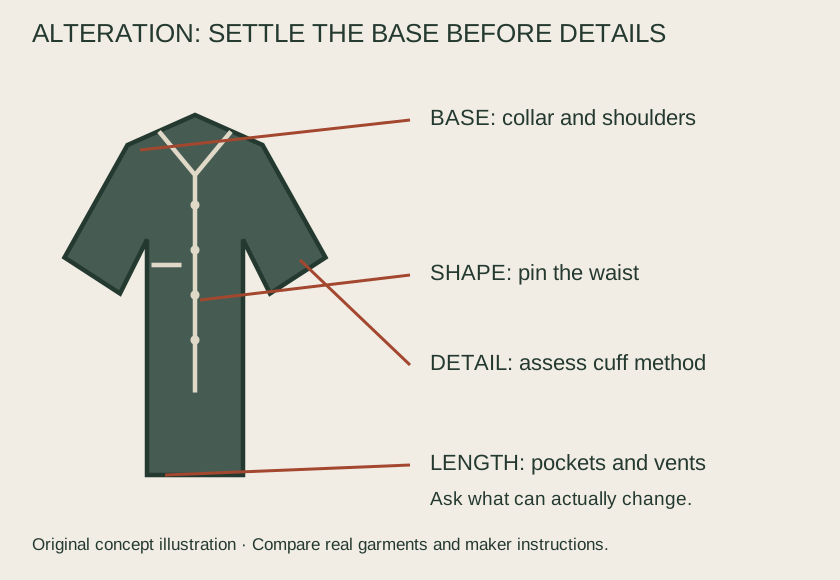
Be careful with overall length
Stand in the shoes and pants you intend to use, then consider the jacket’s overall proportion. Decide whether you like where the hem falls before concentrating on small sleeve adjustments.
Changing length can affect the relationship between the hem, pockets, buttons, and vents. Ask the tailor to explain those relationships for your jacket instead of assuming that shortening it is equivalent to hemming simple pants.
If the entire garment looks too long or too short for the effect you want, try a different length option when available. A short, regular, or long version may offer a more coherent starting point than a major alteration.
You can also compare another style with different proportions. A casual chore jacket and a tailored sport coat serve different visual purposes, and neither needs to impersonate the other to earn a place in your wardrobe.
List all the problems before pricing one repair
Write down every change you think the jacket needs, including areas that feel uncomfortable. A cheap sleeve adjustment can look attractive until you realize it is only one item in a much larger list.
Ask for the total proposed work and any uncertainty before deciding. You are assessing the jacket plus the alteration plan, rather than comparing only the purchase price with a nicer-looking garment on a rack.
Include practical timing in the decision if you need the jacket for an event. A workable alteration that cannot be completed and checked before departure may not solve your immediate problem.
Avoid pressuring the tailor to promise a result that the construction does not support. A candid explanation that another size would be better is useful professional advice, even when you hoped to keep the jacket.
Use pinning as a conversation
Bring the exact shirt, usual shoes, and any layer that materially changes the fit. Show how you stand and move during normal wear instead of trying to reproduce a posture from a menswear photograph.
Ask what the pinned adjustment changes and what it leaves unresolved. For example, shaping through the body may not address a collar gap, and shortening sleeves may not change the fit around the upper arm.
Look at the proposed result from more than one angle. If a second person photographs the front, side, and back with your permission, you can review the overall relationship without repeatedly twisting toward a mirror.
Make sure you understand whether the proposal is reversible or limited by available material. You do not need technical vocabulary, but you do need an honest account of the options before approving work.
Know when a different jacket is the better answer
Consider moving on when the shoulders, chest, sleeve shape, and length all need substantial attention. That combination suggests you are asking a new garment to emerge from a base you do not actually like.
Also consider another cut when sizing up resolves discomfort but creates far more volume elsewhere than you want. The next useful experiment may be a different pattern, not a sequence of increasingly complicated alterations.
A sentimental jacket can justify work that would not make sense for an ordinary new purchase. Say that openly, because preserving something meaningful is a different goal from finding the simplest route to a comfortable everyday jacket.
Likewise, an unusual fit need may make tailoring especially useful. The point is to obtain an informed, garment-specific plan rather than applying a blanket rule that alterations are either always worthwhile or never worthwhile.
Check the result in the same outfit
When you collect the jacket, wear the same base layer and repeat the movements you discussed. Look at the completed areas in ordinary light and raise any concern before assuming you must simply get used to it.
Ask about care and pressing if the work changes how you should handle a detail. Keep the alteration note with the garment information so you can explain its history if future work is needed.
Your successful result is a jacket that suits the way you dress and move. Sometimes that comes from a small alteration, and sometimes it comes from choosing a better base before any stitching changes at all.
Sources & editorial notes
Primary pages checked October 22, 2026. Practical scenarios and style judgments are editorial explanations; exact garment and product instructions take priority.