In this guide
- Find the instructions that belong to the whole garment
- Read the cleaning method before the temperature
- Translate symbols without guessing from their appearance
- Treat bleach as a separate decision
- Plan the exit from the washer
- Check the finishing instructions before reaching for heat
- Build a small sorting system you will actually use
- Make the first wash a repeatable routine
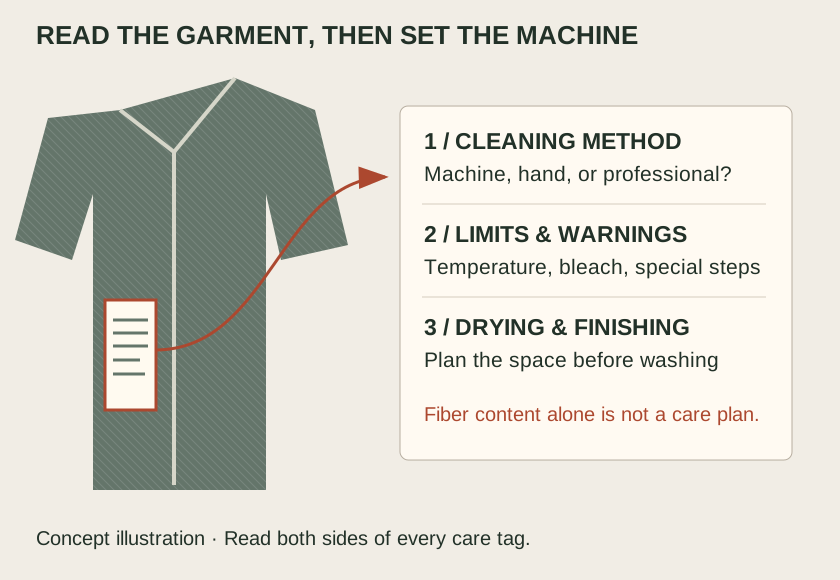
You can avoid a surprising amount of laundry guesswork by reading the entire care label before a new garment reaches your hamper. Start with the cleaning method, check the limits, and decide how you will dry it before you turn on the washer.
The useful question is whether your actual laundry setup can follow the instructions for this particular piece. A shirt that needs flat drying can be an easy purchase when you have a rack, and an inconvenient one when your only option is a shared dryer.
Find the instructions that belong to the whole garment
Look inside the side seam, behind the neck label, and around any attached booklet of fabric tags. Unfold every layer, because the familiar brand name and the practical instructions may sit on different sides.
Your fiber label tells you what materials the garment contains; your care instructions tell you how the finished item should be treated. A cotton outer shell does not tell you how its lining, print, buttons, or internal structure will respond to your laundry routine.
The FTC’s care-label guidance treats the finished garment, including its components, as the relevant item. Read its instructions as a whole instead of selecting the easiest sentence and ignoring the rest.
Imagine two blue shirts that look nearly identical on a hanger. One might be a simple washable shirt, while another has a finish or trim that requires a different process, so sharing a color does not make them laundry partners.
Keep the tag accessible until you know the routine. If a seam label irritates you and you choose to remove it, photograph both sides first and save the images under a name you will recognize six months later.
Read the cleaning method before the temperature
First establish whether the label directs machine washing, hand washing, or professional cleaning. Starting with temperature alone can lead you to overlook a more restrictive instruction somewhere else on the tag.
If the label says dry clean only, do not reinterpret a cold delicate cycle as permission to wash it. If the wording is merely dry clean and you want another method, ask the manufacturer rather than treating the missing word as a home experiment.
A hand-wash instruction deserves its own plan too. Check that you have a suitable basin, time to handle the garment, and an approved way to remove water and dry it afterward.
You may decide that the extra effort fits your week, or that you would rather choose a different garment. Either decision is easier before you own a damp sweater with nowhere suitable to put it.
With machine-washable clothing, match both the stated temperature and the process on your machine. A setting named casual, easy care, or delicate is a machine feature, so consult your washer’s manual if the name does not tell you what the cycle actually does.
Translate symbols without guessing from their appearance
On international-style labels, the tub concerns washing, the triangle concerns bleach, the square concerns drying, the iron concerns ironing, and the circle concerns professional care. The details inside and beneath those shapes matter as much as the basic outline.
GINETEX explains that a number in the wash tub is a maximum Celsius temperature, while bars beneath it call for a milder process. Do not read a number as Fahrenheit simply because your washer is sold in the United States.
A cross through a symbol means that treatment is prohibited. A square with a circle relates to tumble drying; a square with lines can describe natural drying, so check the exact variation rather than treating every square as dryer permission.
US and international symbols are similar but not identical. If the tag mixes words and icons, read both, and use the manufacturer’s interpretation when something appears inconsistent instead of selecting whichever option looks more convenient.
You do not need to memorize an entire symbol chart. Identify the few instructions on the garment in front of you, translate them accurately, and write a plain-English note if that makes the next wash easier.
Treat bleach as a separate decision
A washable garment is not automatically a garment you should bleach. Read any restriction before adding a stain product, and check the product label to see what the bottle actually contains.
For example, an instruction allowing only non-chlorine bleach does not allow you to substitute chlorine bleach at a smaller dose. A do-not-bleach instruction also deserves attention when you are reaching for a multipurpose powder or pre-treatment.
Do not choose a product just because its packaging uses words such as gentle, brightening, or color-safe. Those descriptions do not resolve whether its ingredients and instructions fit your garment’s stated care limits.
If you cannot identify the relevant ingredient or permitted use, pause and look up the product’s instructions. You can always separate a marked shirt from the rest of the load while you work out a suitable treatment.
Plan the exit from the washer
Before you start, identify where the garment will go when the cycle ends. You want the drying method ready, because a successful wash still leaves you with an item whose shape and finish need appropriate handling.
Read tumble-dry limits separately from washing limits. Low drying heat is a different instruction from low washing temperature, and a washer setting does not control what happens in the next machine.
If the garment needs flat drying, prepare a clean surface or suitable rack large enough to support it. If it needs line drying, make sure you can arrange that without improvising over a dusty chair or crowding it into a damp corner.

The organized rail in this scene illustrates why separating garments helps you see what needs attention. It is a wardrobe photograph, not proof that every item shown has the same care instructions or should be dried on a hanger.
For a shared laundry room, bring the instructions with you on your phone. You will have less reason to choose a familiar dryer button automatically when you can quickly reread what this specific garment needs.
Check the finishing instructions before reaching for heat
Read the ironing instruction before treating a wrinkle. If ironing is prohibited, laying a towel over the garment does not cancel that restriction, and a steam appliance is not automatically an approved substitute.
When the label permits ironing, compare its limits with your iron’s instructions. If your appliance uses fabric names rather than temperature settings, its manual is the better guide to those controls than a guess based on the shirt’s feel.
Check for instructions about ironing on the reverse or avoiding a print. Put the garment on a stable surface where you can see the entire area you are working on, including anything sitting beneath the fabric.
You can also decide whether the finish needs attention at all. A softly relaxed linen shirt and a sharply pressed dress shirt have different visual goals, even when both garments have been cleaned correctly.
Build a small sorting system you will actually use
Create three temporary piles: ready for your normal routine, needing a different process, and needing clarification. This is a practical sorting exercise, not a claim that every garment falls into one universal laundry category.
Then separate within those piles according to each garment’s warnings and your laundry-product instructions. A wash-separately note should remain visible in your plan rather than disappearing because the shirt looks close enough to the others.
For a new wardrobe purchase, make a short note with the garment name, wash method, drying method, and any extra restriction. You can keep this in an ordinary notes app without building a complicated clothing inventory.
If the instructions are missing or unreadable, search the brand’s care page using the item number and exact product name. A similar-looking shirt on a resale listing is useful for identification, but it does not establish your item’s care method.
Contact the brand or a qualified cleaner when the answer still is unclear, especially for a structured or valuable piece. Give them the full label, item description, and photographs rather than asking whether all wool or all cotton can be washed.
Make the first wash a repeatable routine
Set aside a moment before your first load to check pockets, identify any required closures, and prepare the approved drying space. Follow the garment’s specific preparation instructions instead of adding a universal rule you saw attached to another fabric.
After cleaning, inspect the item in ordinary light before putting it away. Note any change you want to ask the manufacturer about, and keep that observation separate from assumptions about which part of the process caused it.
The goal is a routine you can repeat without opening five browser tabs every weekend. Read fully once, preserve the useful instructions, and let the label guide your choices every time the garment needs attention.
Sources & editorial notes
Primary guidance checked October 22, 2026. Practical scenarios and illustrations are editorial explanations; garment-specific instructions take priority.