As an Amazon Associate I earn from qualifying purchases.
A good white dress shirt should fit the occasion, close comfortably at the collar, sit properly beneath your jacket, and remain manageable within your real laundry routine. A product called wrinkle-free may still need attention. A shirt described as slim may fit differently from another brand’s slim cut. White itself does not tell you whether a shirt is substantial enough for your preferred underlayer or suitable for a particular formal dress code.
This guide revisits the five original shirt links and separates their checked specifications from practical buying decisions. All five checked selections are white. The linked sizes differ, so compare the actual measurements rather than assuming the link opens your own size. These are researched shopping candidates, not garments we have worn or tested for opacity, stain resistance, shrinkage, or wrinkle performance.
Start with the occasion and the deadline
For an everyday business shirt, think about your office’s expectations and how often you wear a tie. For a wedding or another event, read the invitation and ask about the dress code before selecting the shirt. An ordinary white button-front shirt is not automatically the correct shirt for a tuxedo or a specific ceremonial outfit. Work backward from what you need to wear, including the jacket, neckwear, and cuff arrangement.
Leave enough time to check the fit with that outfit. Delivery estimates, an available size, and a suitable return policy are separate questions. A shirt arriving shortly before an event leaves little opportunity to resolve a wrong sleeve length or a collar that feels too close. If you need tailoring, ask a tailor about the actual garment and the schedule before counting on an alteration to solve every fit problem.
For a frequent office rotation, one satisfactory trial purchase can be more informative than immediately buying several identical shirts. For an event, keep the decision centered on one complete outfit. The cheapest or most heavily promoted option is not necessarily useful when its size, care needs, or collar arrangement do not work for the date you have in mind.
Five original white-shirt choices
Alimens & Gentle: regular fit with a cotton-rich stretch blend
The Alimens & Gentle selection was checked as White, Medium, with 70% cotton, 27% polyester, and 3% spandex. It is listed as a regular-fit long sleeve shirt, with machine washing indicated. This makes it a candidate for someone comparing a conventional button-front shirt with some stretch content. Cotton-rich does not mean all cotton, and the blend does not establish the finished fabric’s opacity or feel.
The listing promotes a stain-shield treatment. Do not read that as waterproof apparel or a guarantee that an accidental spill will leave no mark. Assess the collar, torso, and sleeves first, then check the received care label for treatment-related restrictions. If protection from spills is your main reason for ordering, ask for specific limitations instead of assuming the marketing phrase covers every liquid. A work or event shirt still needs ordinary care and a practical backup plan.
View the Alimens & Gentle White Medium selection on Amazon
Van Heusen poplin: neck-and-sleeve sizing and a roomier cut
The checked Van Heusen selection is White, 15.5-inch neck, 32–33-inch sleeve, listed as 65% reprocessed polyester and 35% cotton. Its regular-fit description, point collar, adjustable button cuffs, and chest pocket distinguish it from a pocketless slim-cut shirt. The listing indicates machine washing and describes its finish as designed to reduce wrinkles; it does not establish a permanently smooth appearance throughout every day.
This is worth comparing when you prefer neck-and-sleeve sizing to a single letter size. Measure according to the current brand chart, and remember that the sleeve range is a sizing designation rather than a guarantee of the exact cuff position on every wearer. Check how the pocket looks beneath your jacket and how the fuller torso tucks into your trousers. Someone seeking a very close silhouette may find a different cut more suitable, while someone prioritizing room should still verify shoulder placement.
View the Van Heusen White neck-and-sleeve selection on Amazon
Kenneth Cole UNLISTED: a nonstretch slim-fit alternative
The UNLISTED shirt was checked in White, 15–15.5-inch neck, 32–33-inch sleeve. The listed composition is 60% cotton and 40% polyester, with machine washing and a slim fit. The checked specifications identify no stretch. That makes its actual chest, shoulder, and torso measurements especially relevant when comparing it with the stretch-blend shirts in this guide.
A slim label alone should not persuade you to order a smaller collar size. If your usual shirt fits at the neck but has too much fabric at the waist, compare the cut rather than reducing every dimension. Try the shirt seated and beneath the jacket you intend to wear. A close fit that pulls between buttons or restricts your normal reach is not improved by a clean-looking product photograph. Ask about the current collar and cuff details if those features determine whether it works with your planned outfit.
View the UNLISTED White slim-fit selection on Amazon
DELCARINO: letter sizing in a three-fiber blend
The DELCARINO selection was checked as White, X-Large. Its composition is 55% cotton, 40% polyester, and 5% spandex, with a slim-fit long sleeve description. The listing specifies machine washing and refers to a cold setting in its care information. Follow the actual garment’s label for the complete routine; that instruction alone does not establish drying or ironing requirements.

This shirt is a candidate if you want to compare a letter-sized slim option with the neck-and-sleeve selections above. Use DELCARINO’s own measurements and clarify whether they describe the garment or the wearer. Do not treat the phrase button-down in a listing as proof of buttoned collar points: button-front closure and collar construction are different details. Confirm the actual collar if you need a particular appearance with a tie, and assess the shoulder fit rather than relying on a blanket recommendation to size up.
View the DELCARINO White X-Large selection on Amazon
J.VER: a regular-fit stretch option in Small
The J.VER long sleeve selection was checked as White, Small, with 62% cotton, 35% polyester, and 3% spandex. Its regular-fit description and spread collar offer another option for comparing a white shirt with neckwear. The listing allows hand or machine washing in cold water and mentions low-temperature ironing. Check the received care label before applying those instructions to a particular garment.
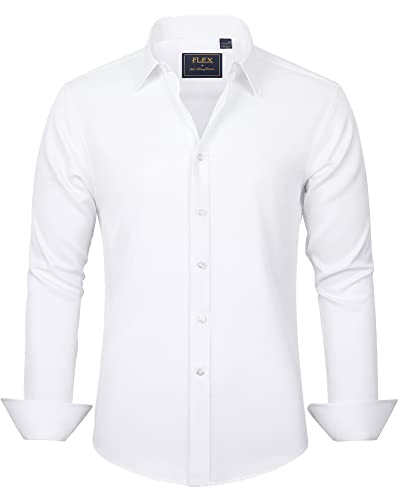
Its wrinkle-free wording should be understood as a marketed feature, not evidence that pressing will never be needed. For a trip or an important event, inspect the actual shirt after the permitted care routine before assuming it can go straight from luggage to a meeting. Stretch content also does not guarantee unrestricted movement. Compare the torso and sleeve measurements with your needs, then try the shirt with the tie and jacket you plan to wear. The checked Small selection should not be confused with a universally suitable size.
View the J.VER White Small selection on Amazon
Get the collar and sleeve measurements right
Measure before comparing size systems
Letter sizing and neck-and-sleeve sizing express different things. A Medium label does not tell you that the collar equals a particular neck size across all brands. A neck measurement does not tell you how much room the body of the shirt provides. Write down your measurements and the method, then compare them with each manufacturer’s current chart.
Charles Tyrwhitt’s measuring guide explains measuring the neck with room for comfort and measuring sleeve length from the center back over the shoulder toward the wrist. It also describes measuring an existing shirt laid flat. That is helpful context for understanding chart methods, not a sizing chart for the five brands above. If a seller measures sleeves from a different starting point, do not compare the numbers as though the methods were identical.
For a shirt you will wear with a tie, close the top button during the fit check. A collar that works open may feel different when fastened. If you usually wear the collar open, still inspect how the points sit under your jacket. Personal comfort and the intended outfit are more useful than a fixed allowance borrowed from an unrelated brand.
Assess cuff position with the jacket on
Try the shirt with your usual watch, jacket, and ordinary arm position. Decide how much cuff you want visible, then check whether the sleeve arrangement supports that appearance without continual adjustment. A cuff button can change the opening at the wrist; it cannot add missing sleeve length. Likewise, rolling a sleeve may be appropriate in a casual setting but does not solve a formal-outfit sizing problem.
Ask whether the actual garment uses button cuffs or another construction before buying accessories. The shirts in this guide should not be assumed to take cufflinks simply because they are called dress shirts. If the event requires a specific cuff style, verify it directly instead of interpreting an ambiguous product title.
Choose the cut that fits your torso, not an idealized label
A regular cut and a slim cut need to be compared using the actual dimensions. Brooks Brothers’ dress-shirt size guide illustrates how one maker distinguishes its cuts and separates body measurements from garment measurements. The useful lesson is that fit is a system within a brand; another maker’s slim shirt may have a different shape and amount of room.
Inspect your shoulder line, chest, waist, and back as a group. If the chest is comfortable but the waist has more fabric than you prefer, consider whether a different cut is appropriate. If buttons pull when seated, the shirt may be too close even if the shoulder looks correct. Stretch content can influence feel, but it is not a substitute for suitable measurements.
For a tucked outfit, try the shirt with the actual waistband height you will wear. Bend and sit normally, then look for excessive bunching or a hem that repeatedly pulls free. Do not alter the shirt before deciding whether its basic size is right. A tailor can discuss possible changes to a particular garment; the availability and cost of those changes should be confirmed, not assumed.
White fabric deserves an in-person check
Inspect transparency with the underlayer you will use
Product photographs do not establish opacity. When the shirt arrives, check it in daylight and your normal indoor lighting, with the undergarment you intend to wear. Look at contrast around the torso, visible outlines, and how the fabric appears beneath a jacket. If you plan to remove the jacket at the event, assess the shirt alone as well.
This is a personal suitability check rather than a claim that one linked product is more transparent than another. A white undershirt is not automatically invisible beneath a white dress shirt. Compare the actual combination and choose what you find discreet and comfortable. If no available underlayer produces the appearance you want, consider that a reason to return or reject the shirt within the applicable policy rather than buying on optimism.
Check the exact shade beside any other white elements in the outfit. A screen may not show whether the received shirt looks bright white or warmer under your lighting. For a coordinated occasion, do not assume two differently sourced white garments match because their color names are identical.
Confirm fibers instead of inferring them from the title
None of the five checked selections is listed as pure cotton. Their cotton, polyester, and spandex percentages differ; Van Heusen’s checked listing specifically describes reprocessed polyester. The FTC’s textile-label guidance describes fiber-content labeling. Compare the received label with the selected product description, especially if a particular material matters to you.
Fiber percentages do not establish fabric weight, weave quality, opacity, or how soft a finished garment will feel. A poplin name describes a fabric category, not an assurance that every poplin shirt performs identically. If the listing omits a detail you need, ask for it. Avoid using customer photos of another color or size as proof of the exact white shirt you are ordering.
Treat easy care as a complete routine
Wrinkle-free and wrinkle-resistant language can make a shirt appealing, but neither phrase supplies a complete laundry plan. Before buying, check washing, drying, ironing, and bleaching instructions separately. White color alone is not permission to use bleach, and a cotton-rich blend does not establish an appropriate high iron setting.
The FTC care-label guidance explains that instructions apply to the finished garment and can include warnings. Use the actual sewn-in label. If the selected listing and the received label disagree, resolve the discrepancy before laundering. This is particularly relevant when a treatment is marketed as part of the shirt’s appeal.
Think about the morning after laundry rather than only the first unboxing. Do you have time to press a shirt if needed? Can you follow its drying instructions? Is there a clean spare when a shirt is unavailable? A useful white-shirt rotation matches your routine. It does not depend on every garment staying pristine without attention or on a treatment lasting indefinitely.
For an event, prepare the shirt in advance under its approved care instructions and inspect it again with the full outfit. Keep it somewhere appropriate until needed. If you travel, plan how you will handle creasing within the label’s restrictions rather than assuming a hotel appliance or improvised treatment is suitable for every fabric blend.
Compare the cost of a wearable outfit
The relevant cost includes more than the listed shirt price. Consider shipping, any confirmed alteration, care requirements, and accessories you actually need for the occasion. Do not buy a different tie or jacket merely to make an unsuitable collar seem workable unless that is a deliberate wardrobe choice. A shirt that fits your existing outfit can be more useful than a lower-priced item that starts a series of additional purchases.
Compare current return conditions before choosing several sizes to try. Check deadlines, tag requirements, and whether laundering or alterations affect eligibility. Do not assume policies are identical across sellers. Keep the order selection, size chart, and correspondence until you have resolved any mismatch; these details are more helpful than remembering that you ordered a white shirt from a familiar brand.
A final fitting appointment with yourself
Set aside a few minutes to try the complete outfit before you commit to the shirt. Button it as you will wear it, put on the intended trousers and jacket, and check ordinary seated and standing positions. Inspect the placket, collar, cuffs, shoulder placement, and tucked hem. Ask someone you trust for a second view if that helps, but keep comfort and the actual dress requirement central.
- Confirm the ordered white selection, size, fiber label, and care label.
- Check neck comfort with the intended collar position and neckwear.
- Check sleeve position with your jacket and watch.
- Assess transparency with the actual underlayer and lighting.
- Resolve obvious defects, mismatched specifications, or an unsuitable fit before washing or tailoring.
Keep the useful measurements for your next purchase
Once you find a shirt that works, record its brand, selected size, and the dimensions you actually liked. Note whether it is comfortable with a closed collar and which trousers and jacket you wore. Keep that reference separate from a general label such as slim or regular. It gives your next purchase a practical comparison point, while still leaving room for changes in a maker’s pattern or your own preferences.
Does the most cotton automatically mean the best shirt?
No. The useful choice depends on fit, appearance, care preferences, and the finished fabric. Cotton percentage is one specification to compare. It does not rank these garments for quality or establish that they have been tested under identical conditions.
Can one shirt cover work, weddings, and every formal event?
Only when each occasion permits the same style. Check the event requirements and outfit details individually. A white shirt can be versatile without being universal. Choose the garment that fulfills your specific need, then make its fit and care routine part of the decision rather than relying on broad occasion lists in the sales copy.