Disclosure: As an Amazon Associate I earn from qualifying purchases.
Black dress shoes are easiest to buy when you know which outfit they must finish. A quiet cap toe for a client meeting, a convenient loafer for an office wardrobe, and a perforated casual Derby solve different problems. The color alone does not make those shoes interchangeable. Shape, fastening, sole appearance, material, and fit all affect whether a pair belongs with your trousers and the occasion.
The five options below are the original black selections, with their materials and sizing checked separately. They are shopping candidates, rather than a ranking from personal wear tests. Cushioning features do not establish medical benefits, certified slip resistance, or comfort for every foot. Use the descriptions to narrow the style, then use the fit checks to decide whether the actual pair deserves a place in your wardrobe.
Start with the clothes you will actually wear
Put together the complete outfit before opening a size menu. Lay the shoes beside the trousers, socks, jacket, and belt you plan to use. A shoe that looks restrained in a cropped photograph may have a chunky sole or strongly rounded toe when seen under a narrow trouser hem. Conversely, a simple black lace-up can look perfectly appropriate with a suit without being suitable for a stricter evening dress code.
For a conservative business outfit, start with a smooth upper, restrained decoration, and a sole profile that does not dominate the trouser line. For a relaxed office, a loafer or casual Derby can be easier to integrate. If the invitation specifies black tie or another particular dress code, confirm the host’s expectations instead of assuming that every black shoe qualifies. Dress-sneaker styling is especially worth checking before buying for a ceremony.
Three questions that cut through the catalog
- What is the most demanding occasion? A pair bought principally for occasional suit wear should be judged with that suit, even if you also hope to wear it with chinos.
- Will you wear these repeatedly or only for one event? Frequent use makes fit, cleaning, and how the upper looks after creasing more relevant than a single attractive product photograph.
- What bothers you about your current shoes? Heel movement, pressure across the instep, an overly long toe, or an awkward trouser break are specific problems. A general claim of extra comfort does not address them automatically.
Five black options, with different wardrobe roles
Clarks Tilden Cap: a leather cap toe for a restrained outfit
View this selected option on Amazon
This original selection is Black Leather, US size 12. The Tilden Cap has a leather upper and lace fastening, with a cap-toe seam that gives it a more traditional dress appearance than the perforated casual option below. Clarks identifies this model as a Derby lace-up on its Tilden Cap product page. Marketplace titles may use Oxford more loosely; the actual construction and appearance are more useful than that label alone.
Consider it for a wardrobe centered on dark trousers and suits, particularly if you prefer a separate toe cap to a completely plain vamp. Its advertised cushioned footbed is a construction feature, not proof that it will accommodate your foot shape. Before ordering, confirm the black leather option, your required width, and the return terms for indoor fitting. The linked size is a particular selection, not a sizing recommendation for everyone.
Bruno Marc SBOX223M: a plain upper with a casual sole profile

View this selected option on Amazon
The checked selection is Black, US size 13, with a faux-leather upper, microfiber lining, and lace fastening. This is a casual dress shoe with a sporty outsole appearance. That combination makes it a candidate for someone who wears chinos or relaxed office trousers and wants a plain black upper, while retaining a less traditional look beneath it.
Judge the complete side profile before pairing it with a formal suit. The listing describes a padded latex insole, but that does not establish an orthopedic function or a measured reduction in fatigue. It also does not make the shoe appropriate for jobs requiring certified footwear. Check how the sole looks against your trouser hem, whether your width is available, and whether the lining feels agreeable with your usual socks. Avoid treating a favorable photograph as evidence of long-term durability.
Bruno Marc Downing-02: a simple synthetic lace-up
View this selected option on Amazon
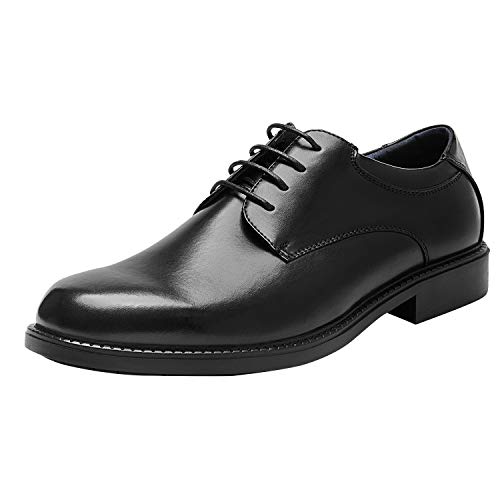
This original link currently identifies a Black, US size 12 lace-up with a polyurethane/faux-leather upper. The listing mentions a leather lining, but that does not make the outer shoe a leather shoe. Material descriptions should distinguish the component you are touching, cleaning, or expecting to age; the headline’s leather wording is not enough.
The uncomplicated upper makes this an option to inspect for business trousers or an occasional event where a plain black lace-up fits the dress code. The listing warns that fit may be narrow. Treat that as a reason to examine the size chart and width carefully, rather than an instruction to increase every buyer’s size. Extra length may leave heel movement while the forefoot still feels compressed. Check the fastening, toe shape, and return conditions before choosing between nearby sizes.
Clarks Tilden Free: a leather slip-on for a quieter office wardrobe
View this selected option on Amazon
The exact checked selection is Black Leather, US 10.5 Wide. The Tilden Free is a leather-upper loafer with no laces to adjust. Its slip-on form can suit someone who prefers a clean upper and frequently wears office trousers without wanting a lace-up every day. Clarks’ Tilden Free model description confirms the black leather slip-on identity.
The important limitation is fit adjustment. A loafer must hold your heel and instep without depending on tightened laces. The wide designation on this link does not establish that all available variants share that width. Try it with the socks you expect to wear, check for heel lift while walking, and avoid solving looseness by accepting pressure elsewhere. The original listing’s odor and fungus claims are not a reason to choose it for a health concern.
Bruno Marc SBOX2336M: perforation and a business-casual emphasis

View this selected option on Amazon
This selection is Black, US size 11. The exact product identifies the SBOX2336M model, a faux-leather lace-up with visible perforation and a casual Derby silhouette. Those details give it a different role from the smoother cap toe: consider it alongside chinos, an unstructured jacket, or other outfits where a relaxed shoe is welcome.
Perforated styling should not be turned into a promise that your feet will stay cool throughout a particular workday. Nor is a cushioned insole evidence that the shoe will suit prolonged standing on every surface. Check the actual upper, lining, sole, and width selection on the order page. If you need one pair principally for conservative suit wear, compare this design carefully against the smoother choices. A suitable everyday style can still be the wrong purchase for a stricter event.
Fit the shoe to your foot, rather than your usual number
Shoe sizes are a starting point. Two black lace-ups bearing the same number can differ at the heel, instep, forefoot, and toe. A wide label also describes a particular version; it is not an assurance that every part of the shoe is roomy in the way you need. Keep a note of the brand, model, size, and width of a pair that already fits you well, but do not assume that a new style will duplicate it.
For an online purchase, look for a usable size chart and a clearly stated return process. Confirm whether the chart describes foot length or another measurement, and follow that chart’s own method. Photographing your current shoe label can prevent confusion between US, UK, and European numbers. When a listing offers several markets’ sizes, verify the system on the selected order rather than converting casually in your head.
A useful indoor fitting sequence
- Put on the socks intended for the outfit. Thick casual socks and thin dress socks can change the experience enough to make a quick trial misleading.
- Try both shoes. Notice whether either foot feels crowded, and inspect toe clearance without relying on a single universal thumb-width rule.
- Fasten lace-ups normally, or settle your foot fully into a loafer. Walk on a clean indoor surface permitted by the return policy.
- Check the heel, the widest part of the foot, and pressure across the top. Sit, stand, and walk again; a shoe should remain acceptable during those ordinary movements.
- Reject persistent pinching, toe contact, or excessive heel movement. Do not plan around a promise that painful shoes will become comfortable after a fixed break-in period.
Take your trousers into the trial as well. Check the outfit in a full-length mirror rather than studying only the toe. If a long front makes the shoe feel visually disproportionate, moving down a size can introduce a fit problem. Look for a different shape instead. The right number and the right silhouette are related decisions, but one cannot safely substitute for the other.
What comfort descriptions can and cannot tell you
A padded footbed can tell you that cushioning is part of the design. It does not tell you how your heel sits, whether the arch contour feels right, or whether the upper presses across the instep. Those interactions may be more noticeable than softness during an initial trial. Compare the actual shoes under similar conditions, using the same socks and the same short indoor route, rather than comparing one listing’s adjectives against another’s.
If you use an existing prescribed insert, check the shoe’s compatibility with your clinician’s advice and the maker’s construction information. Do not assume that an insole is removable because a listing says cushioned, and do not stack inserts simply to correct a poor fit. A product marketed as comfortable is not a treatment for a foot condition. If health requirements govern the purchase, use those requirements to narrow the shoe before considering its outfit appeal.
Sole material is similarly incomplete evidence. Rubber or thermoplastic elastomer does not by itself establish a tested slip-resistance rating. None of these descriptions should be read as a guarantee on wet paving, polished floors, or workplace surfaces. If your work specifies certified protective footwear, shop to that specification. A dress shoe’s visual suitability for the office is a separate question from its suitability for a particular workplace hazard.
Buy the material you intend to maintain
Leather and faux leather can both appear black and polished in a photograph, while requiring different care. The two Clarks selections have leather uppers; the three Bruno Marc selections here have synthetic uppers. That difference matters when selecting cleaning products and setting expectations for the finish. Neither category establishes the lifetime of a particular pair without information about its construction, use, and care.
Read descriptions by component: upper, lining, insole, and outsole. A leather lining inside a polyurethane upper does not turn the upper into leather. A product title can be abbreviated, translated, or loosely categorized, so it should not override the material fields for the selected model. If those fields contradict one another on a detail that matters to you, ask the seller or maker for clarification before ordering.
A modest care plan is more useful than a shine promise
For smooth leather, remove loose dirt gently and use care products specifically appropriate for the finish. Clarks’ shoe-care guidance recommends testing polish on an inconspicuous area before applying it more widely. Treat that as a material-specific starting point, not a reason to use the same product on patent leather, suede, or a synthetic upper.
For the synthetic choices, follow their own care instructions and begin conservatively. Do not assume that leather conditioner, strong solvents, or machine washing is appropriate. A damp cloth mentioned for one model is not permission to soak another. When you are uncertain about the finish, stop before experimenting with a cleaning mixture. Keep care materials away from the outfit until you know they will not transfer color onto your trousers or socks.
Cleaning also means noticing condition. Inspect the sole edge, fastening, and upper periodically, especially before an event where you cannot easily change shoes. If the sole separates or the fastening fails, polishing the toe will not resolve the problem. A repairer can advise on a particular pair’s repair options; do not assume these shoes are all resoleable or that a repair will always be economical.
Build a purchase around a realistic occasion
For a new office wardrobe, choose the pair that works with the trousers you wear most often. A restrained smooth upper may be more useful than an unusual detail you enjoy in isolation. If the office is casual, compare the loafer and perforated Derby without assuming that either must work for every client-facing appointment. Keep the expected dress code as your first filter and fit as the deciding filter.
For a wedding or another fixed-date event, leave time for delivery, an indoor trial, and a possible return. Check the event’s dress instructions and the venue conditions separately. An attractive shoe that arrives the day before gives you little opportunity to discover a poor fit. If you already have a suitable pair, compare the new purchase against it honestly rather than feeling obliged to wear new shoes because they were bought for the occasion.
For travel, write down how much of the trip involves formal clothing and how much involves walking between locations. One black pair may coordinate with several outfits, but coordination does not establish its suitability for your entire itinerary. Avoid assuming that casual sole styling makes a dress shoe a walking sneaker. Pack according to the activities you actually expect, and check your shoes’ condition before leaving rather than discovering damage after arrival.
Keep the budget tied to use
Compare the delivered price, applicable return costs, and any resizing or care purchases you actually need. Avoid setting a universal price threshold for quality: a lower price does not make a shoe disposable, and a higher price does not prove it will fit better. If you only dress formally a few times a year, the simplest suitable pair can be a reasonable choice. Frequent wear may justify more attention to maintenance and how the design fits your recurring outfits.
Check the selected order before paying
Before deciding, make a small wardrobe note: the outfit this pair must accompany, the size and width you tried, the socks used, and any pressure or movement you noticed. If you compare two pairs on different days, those details make the comparison more useful than remembering that one seemed softer. Include a photograph of each with the same trousers if silhouette is the unresolved question. You can then choose by the actual problem you are trying to solve.
For occasional dress wear, check the shoes again ahead of the next event. A pair stored for months can still need cleaning, inspection, or a fresh fit assessment with a changed outfit. For frequent office use, pay attention when fit or condition changes instead of assuming the first successful trial settles every future use. These simple observations are more actionable than predicting a fixed number of years of service from a material label.
The product links above refer to specific selections observed during review. Size and color menus can change the item being ordered. Confirm the final selection even if the photograph still appears black. Review the model name, size system, width, material, seller, condition, and return terms in the cart. Save the order details so that a mismatch between the listing and delivered pair is easy to explain.
When the shoes arrive, check that both labels and the box match the order, then inspect for obvious damage or inconsistent construction. Complete the indoor fit trial before wearing them outside if the return policy requires that. Choose the pair that meets your occasion and fits acceptably now. That combination is more dependable than selecting a dress shoe on claims of universal comfort, premium quality, or guaranteed traction.