Disclosure: As an Amazon Associate I earn from qualifying purchases.
A 38mm watch can sit comfortably within an everyday wardrobe, but the number is only one part of its appearance and fit. A plain analog dial, a bright numeral layout, a two-tone bracelet, and a digital sports display can all occupy this size category while serving quite different needs. Decide what you want to read, wear, and operate before treating a shared case size as evidence that the watches are interchangeable.
The original five candidates below have been checked by exact product and model. They include dress-oriented and casual choices, with a specific dimension conflict noted for one model. These are buying comparisons, not claims from personal testing. Where a listing and manufacturer information differ, the discrepancy matters more than a confident label. A good purchase is the selected watch whose size, functions, and appearance match your own routine.
What the 38mm measurement describes
Case diameter refers to the width of the case, rather than the visible dial or the strap. Timex’s Weekender sizing information describes this measurement as excluding the crown. That distinction helps explain why a photograph’s face can look much smaller than its advertised size. Check the manufacturer’s measurement for the specific model, especially where a seller calls both the case and the dial its watch size.
Do not stop at width. The distance between the ends of the lugs affects how far the watch extends along the top of your wrist. Thickness affects how it passes beneath a shirt cuff. The crown and buttons can affect how it feels when you bend your hand. A strap that adds material under the case can also change the wearing experience. None of those considerations has a universal answer based solely on your wrist circumference.
A practical comparison is a watch you already find comfortable. Note its case width, overall length where available, thickness, and strap arrangement. Compare the new candidate against that baseline without treating an online wrist-size rule as an obligation. Some people deliberately prefer a smaller dial or a more prominent sports watch. The useful question is whether the whole watch works on your wrist with the clothes and activities you have in mind.
The original five choices, by the job they do
Bulova 96B149: black dial and a silver-tone bracelet

View this selected option on Amazon
The exact original product is the 96B149, a quartz analog watch with a black dial, date display, silver-tone stainless-steel case and bracelet, and domed mineral crystal. Bulova’s specific model page specifies a 38mm case width. The marketplace’s separate measurement field says 37.7mm, so use the maker’s model specification as the nominal size reference and confirm the supplied model if exact measurement is essential.
Consider this if you want a relatively restrained bracelet watch to accompany office trousers or a suit. The black dial and silver-tone finish offer a different visual result from the two-tone candidate below. Bracelet fit still requires attention: ask how links are adjusted and keep any removed links. The maker describes the watch as splash resistant. Treat it as a dress-oriented daily candidate, rather than choosing it for swimming on the strength of a water-depth label.
Timex Easy Reader TW2V266009J: blue dial with a black leather strap
View this selected option on Amazon
The exact selected Easy Reader is TW2V266009J, with a blue dial, silver-tone case, and black leather strap. Its specific product measurements list a 38mm case and a 20mm band width. That identifies this version; other Easy Reader watches can have different sizes and dial combinations. Check the complete model reference rather than assuming the collection name identifies one universal watch.
This is a candidate for someone who wants an analog display and a leather strap instead of a metal bracelet. Evaluate the actual numerals, hands, reflections, and date window in the available close-up views. The name Easy Reader does not guarantee effortless reading for every person or in every light. Try the strap-hole positions and case placement when it arrives. The listing’s 30m label should not be interpreted as permission to swim; confirm the model’s own use instructions before exposure to water.
Bulova 98H18: a two-tone option with a dimension discrepancy to resolve
View this selected option on Amazon
The original product identifies 98H18, with a silver sunray dial, gold-tone accents, a two-tone stainless-steel bracelet, quartz movement, and a date display. Bulova’s From the manufacturer specification table on the exact product page names 98H18 and gives 38mm case diameter. However, the same marketplace page’s general measurement table gives 40mm. This is a real conflict, not a reason to substitute a different model’s dimensions.
Retain this as a conditional candidate if the two-tone appearance suits your wardrobe. If a true 38mm case is your non-negotiable requirement, obtain confirmation for the supplied 98H18 before ordering; do not rely on the headline alone. The decorative contrast can appeal if you already wear mixed metal accessories, but that is a style preference, not a quality ranking. Confirm bracelet adjustment and the return process. Treat its stated 30m water rating conservatively and follow the supplied instructions.
Timex Weekender T2N651: cream dial and an olive fabric strap
View this selected option on Amazon
This original Weekender is T2N651, with a cream dial, silver-tone case, and green/olive fabric strap. Timex’s model specifications confirm a 38mm case and 20mm band/lug width, along with an analog quartz display, 24-hour dial markings, and INDIGLO illumination. These facts belong to this model, not every watch sold under the Weekender name.
The fabric strap and numeral layout make it a candidate for casual clothing rather than a substitute for every dress watch. Decide whether the inner 24-hour markings help you or make the dial busier than you prefer. The maker describes its 30m water resistance as appropriate for incidental splashes, not swimming or diving. Compare how the strap sits under your cuff and how the buckle feels while typing. Illumination is useful to consider, but it does not establish a particular battery life in your routine.
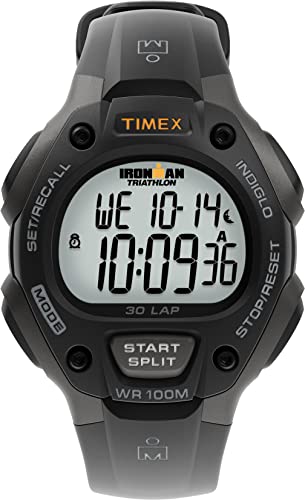
Timex IRONMAN Classic 30 T5E901SU: digital functions in a resin case
View this selected option on Amazon
The exact original listing identifies T5E901SU. Timex’s T5E901 model page specifies a 38mm gray resin case, digital display, black resin band, and 16mm band/lug width. Its functions include timers, alarms, and illumination. This is a sports-oriented digital choice, with an appearance and interaction quite different from the analog bracelet watches.
Consider it if you will actually use those functions and prefer a digital display. Confirm that its menu and button arrangement suit you by reading the supplied instructions rather than assuming every mode is intuitive. The maker lists 100m water resistance and allows specified swimming uses, while excluding scuba diving and button operation underwater. Follow that exact guidance and consider the watch’s condition. Its case size does not make its strap interchangeable with the 20mm Timex analog straps above.
Decide what you need to read on an ordinary day
Begin with the simplest task: checking the time at the distance and angle you normally use. Large numerals can help some readers, but hand contrast, reflections, dial layout, and the size of the date window also matter. A clean photograph under studio lighting is not the same as your view beside a bright window or in a dim restaurant. Look at several product views and make readability part of the return-period trial.
For analog choices, decide whether you want a date. A date display is convenient only if you can read it and are willing to keep it set appropriately. Do not infer a perpetual calendar from the word calendar. If you rarely consult the date on your wrist, a different aspect such as dial contrast or cuff clearance may deserve more weight. Small features should not be treated as universally useful merely because they lengthen a specification list.
For the digital IRONMAN, write down the functions you expect to use rather than buying by the largest feature count. A timer for a repeated activity, an alarm for a reminder, or a chronograph for an elapsed interval are distinct tasks. If you do not need them, a simpler analog option may fit your routine better. If you do, confirm how modes are entered, how settings are changed, and whether the display remains understandable during the intended activity.
A short readability trial
- Read the time with the watch in its normal position, rather than holding it close solely to appreciate the dial.
- Check it beside the clothes you commonly wear, including a shirt cuff if relevant.
- Try the date and secondary markings individually. Decide whether they are useful or add visual clutter for you.
- Operate illumination or ordinary buttons only as allowed by the instructions. Notice whether you can do so comfortably without shifting the watch excessively.
- Compare your impression with your existing watch. Keep personal preference separate from a claim of objectively superior legibility.
The bracelet or strap can decide whether the watch fits
A bracelet and a leather, fabric, or resin strap behave differently. Choose by your expected wear and adjustment needs, not by the idea that one material is inherently more masculine or premium. A metal bracelet offers a continuous visual match to the case but may require link adjustment. A strap offers buckle positions but those positions may fall between your preferred fits. Neither arrangement guarantees comfort on every wrist.
Ask how much adjustment the bracelet clasp permits after links have been removed. On a strap, check usable length and hole positions where those measurements are provided. A band described as adjustable still has a finite range. For a gift, obtain a useful wrist measurement or choose a return process that allows the recipient to assess fit. Guessing solely from the recipient’s height or clothing size is unlikely to resolve watch fit reliably.
Do not buy replacement straps by case diameter
The width between the attachment points matters. A 38mm case does not require a 38mm strap, and these candidates do not all use the same width. The Weekender’s maker specifies 20mm, while the IRONMAN’s maker specifies 16mm. For the 96B149, Bulova specifies 18mm lug width even though the marketplace lists a 20mm band measurement. Confirm the correct attachment dimension for the exact watch rather than averaging conflicting numbers.
Also confirm the shape of the attachment and the hardware required. A nominal width does not establish compatibility with every straight-ended replacement or every spring bar. The existing bracelet may have fitted ends, and a sports band can have a model-specific profile. Keep replacement shopping separate until you know what the watch actually accepts. Do not force an attractive strap into place or assume that a loosely fitting bar is satisfactory.
Match the watch to your clothes without buying a uniform
Try the watch beside two or three complete outfits you wear regularly. For office use, compare the dial and case against a shirt cuff, jacket, and any accessories you actually carry. The silver-tone black-dial Bulova can look quieter than its two-tone counterpart; the blue Easy Reader adds color without requiring a matching blue outfit. Those are visual directions to assess, rather than rules about which watch every professional should wear.
For relaxed clothing, the olive Weekender provides a different texture from a polished bracelet. Its fabric strap may suit the atmosphere of a casual wardrobe, but you still need to judge fit and the way it sits. The digital IRONMAN makes its function visible in the design. That can be appropriate for your daily activities even if it is not your preferred companion to a formal outfit.
If you want only one watch, define the occasions where you genuinely expect to wear it. A choice that coordinates reasonably with your recurring outfits may be more useful than one selected for an imagined exceptional event. Conversely, someone buying a dedicated dress watch can prioritize cuff clearance and a restrained dial without requiring a timer. The best compromise depends on the tasks you are prepared to leave to another device.
Read water resistance as instructions, not a depth challenge
Water-depth markings are not an invitation to use a watch at that depth. Read the guidance for the particular model, including whether buttons or the crown may be operated when wet. The 30m analog candidates should not be treated as swimming watches merely because a marketplace category says swimming. The Weekender’s manufacturer specifically excludes swimming and diving; the 96B149’s manufacturer describes splash resistance. Those distinctions matter more than a broad collection label.
The IRONMAN has different maker guidance, but its stated rating is still not a promise about every exposure or a damaged watch. Confirm allowed activities, the condition of the watch, and any maintenance needed after a case has been opened. A leather strap’s care requirements also remain relevant even when a case carries a water-resistance rating. Do not assume that case and band have identical tolerance of water, cleaning chemicals, or prolonged soaking.
Before cleaning, follow the specific watch and strap instructions. Avoid improvising a whole-watch soak or abrasive treatment based on advice for another model. If the crown, crystal, seal, or strap is damaged, arrange appropriate service rather than testing the limits yourself. You do not need a universal water-resistance conversion chart to make a sound choice; you need the maker’s actual permitted uses for the watch you buy.
Plan for ownership after the first week
These candidates use battery-powered quartz movements. That does not establish the same battery life across analog and digital models or across different patterns of illumination and alarms. Check the exact model’s service instructions when battery replacement is needed. Arrange competent servicing where required rather than assuming that opening the case has no consequences for its sealing or warranty. Keep the model reference available so that a service provider can identify the correct parts.
Budget for the adjustments you already know you need. Bracelet sizing, a future strap replacement, battery service, or shipping for a return can matter more than a small difference in purchase price. Use actual local quotations where relevant; there is no single service price that applies to every retailer and region. Check the seller, condition, and warranty eligibility before assuming a marketplace offer has the same terms as a direct manufacturer purchase.
Inspect an arriving watch before removing packaging that the return policy requires. Confirm the model and color combination, check for obvious damage, and try the ordinary controls described in its instructions. Test how it sits while your arm rests at a desk and while your hand moves normally. A watch that looks proportionate but constantly needs repositioning may not be your best fit. Record any discrepancy promptly rather than relying on a vague memory of the listing.
A final selection checklist
When two candidates seem equally appealing, compare them through one typical day rather than through the largest specification list. Picture reading the time during your commute, working at a desk, wearing your normal outer layer, and putting the watch away afterward. Note the decisions that remain unresolved: strap fit, glare, button access, or a measurement conflict. Answer those questions with the actual model information and an allowed fitting trial. That gives you a clearer reason to buy than a broad claim that one watch suits every man’s wrist.
- Confirm the exact reference and selected color combination, rather than relying on a family name such as Easy Reader or Classic.
- Check case width separately from dial size, strap width, thickness, and overall length. Resolve the 98H18 dimension conflict if 38mm is essential.
- Choose the dial and functions you can comfortably read and operate in your intended setting.
- Confirm bracelet or strap adjustment, and verify the attachment specifications before purchasing replacements.
- Read the model’s water-use and care instructions; do not infer swimming permission from a marketplace category.
- Review seller, condition, warranty, delivery, and returns, then allow time to assess the delivered watch.
Choose the watch whose ordinary use makes sense to you. A smaller case can be an appealing style choice, but accuracy of the selected model, comfortable fit, and clear ownership expectations make that choice easier to live with.